Hello everybody, welcome to my recipe page, If you're looking for new recipes to try this weekend, look no further! We provide you only the perfect My Grandmother's DIY Udon Noodles recipe here. We also have wide variety of recipes to try.
Before you jump to My Grandmother's DIY Udon Noodles recipe, you may want to read this short interesting healthy tips about {Easy Ways to Get Healthy. Becoming A Healthy Eater
Camp cooking can be as complicated or simple as you would like it to be. If you want to prepare fast and easy but nutritious meals while you are camping, camp cooking does not even have to need a fire. However, if you’re interested in fueling your camping trip having a feast, then camp cooking can make it possible for you to earn hot, healthy foods that are as great as you can create them at home in your kitchen.
Just about any cooking procedure you are using in the kitchen can be duplicated around the campfire. For instance, use a toaster or pit cooking to bake your food. You might also easily fry foods at a bowl over a grill, or boil, braise and roast. What type of camping cookware is best for you? Camp cooking and cleanup may be easy or a hassle, and it all starts with great camping gear.
Some pots/pans come in places that mate jointly or"nest" for storage and also allow you to tuck a spoonful of gas within them. This also comes in handy when you’re wanting to save space whilst camping.
Listed below are some camping items to carry with you if you are thinking about preparing some meals around the campfire. These frequent kitchen items will allow you to replicate yummy meals when you are out of doorways.
• Other of your favorite herbs and spices • Cooking oil • Pot holder
• Aluminum foil • Tongs and spatula • Cutting knives • Cutting board • Mixing bowl
If you have only a couple of campers and are looking for some simple camp cooking, try the simple and speedy technique of tin may cooking. All you’ll need is a clean tin can – a 1 gallon size may works well. Your source of warmth can be a little campfire, or when wood burning is prohibited, a small buddy burner may work well, which can be seen at sporting good stores or online. Place your meal from the tin could and just heat the contents of your can over a fire. This technique works great for soups, beans and tuna fish.
A more time-consuming pub cooking technique which also produces tasty food is pit cooking. It is also a wonderful camp cooking system if you’re using a dutch oven or cast iron cookware. Pit cooking warms your food by heating rocks and coals that are concealed in the floor. As the stones cool away, their emitted heat cooks the food. To pit cookfirst dig a hole that is approximately three times bigger than your cookware. Line the pit with stones and build a fire in the middle. Once the flame has burned rapidly for about an hourpush the hot coals and stone into the middle. Layer your wrapped food covered skillets on top of the stones and coals and place more on top. Following a few hours, you’ll have some delicious camp food to enjoy.
We hope you got insight from reading it, now let’s go back to my grandmother's diy udon noodles recipe. You can cook my grandmother's diy udon noodles using 4 ingredients and 22 steps. Here is how you cook that.
The ingredients needed to prepare My Grandmother's DIY Udon Noodles:
- Take 200 grams White flour
- Use 2 tsp Salt
- Get 75 ml Water
- Prepare 1 Flour for dusting (flour or katakuriko)
Steps to make My Grandmother's DIY Udon Noodles:
- Combine the flour and salt in a bowl. Add half the quantity of water.
- Mix the flour that has been saturated with water in the center of the bowl. Gradually add water and mix into the center so that the mixture takes on the appearance of panko.
- Squeeze and knead the fine crumbs together to form a lump. Add water if necessary, but not too much.
- It will eventually form into a cohesive ball.
- Put in a plastic bag and knead with your feet. This adds elasticity and gives a chewy texture to the noodles! It is possible to mix with your hands, if you put enough strength into it.
- The dough will spread out as you knead, so bring the dough together from time to time and knead for 10 minutes (as seen in the photo, I kneaded the dough by folding it in, and peeled off the plastic each time).
- Roll the dough into a ball. Wrap in plastic wrap or leave it in the bag, and let rest for over an hour (leave it as is).
- Since it's already in the bag, flatten the dough with your hands and spread it out slightly.
- Leave the dough in the plastic bag and roll out with a rolling pin, Wrinkle marks from the plastic may transfer to the dough, so peel it off occasionally (I rolled out the dough to the size of the bag).
- Remove from the bag. Dust your work surface, the rolling pin, and the udon dough with flour using your hands and rub in (I used wheat flour this time). As my cutting board is small, I spread out the plastic bag and lay it on top of it.
- Roll out the dough on your work space. Dust your workspace, rolling pin, and the dough with flour well so that they don't stick. Wrap the dough around the rolling pin, flip it over, and spread the dough out evenly to the four corners (it's easy to turn the dough over if you roll it around a rolling pin).
- I rolled out the dough to the size of the bag. My cutting board and rolling pin are small, but I was able to roll it out into a long oval.
- When the dough is rolled out to your preferred thickness, fold into three or four, and slice from the edge with a knife (I folded into three).
- Sprinkle flour on the cut strips and loosen them apart (the cut edges are prone to sticking, so be careful).
- All the noodles have been cut. While cutting, I started making them a bit fatter so the thickness of the noodles varies somewhat. When they're boiled you'll notice the difference, so please try to keep them to a uniform thickness.
- In a pot, bring plenty of water to the boil.
- Drop the loosened strands into the boiling water. Keep the pot boiling and stir occasionally so the strands don't stick (I only have a small pot, but it's best to use a large one).
- If the pot looks like it's about to boil over, add 50 ml of water. It'll prevent the pot from boiling over, but it'll also decrease the temperature of the water, so don't add too much! You could also lower the heat.
- Boil the noodles for 8-10 minutes, and once the strands float to the surface, bite into one to check the texture. If it has cooked through, they're done.
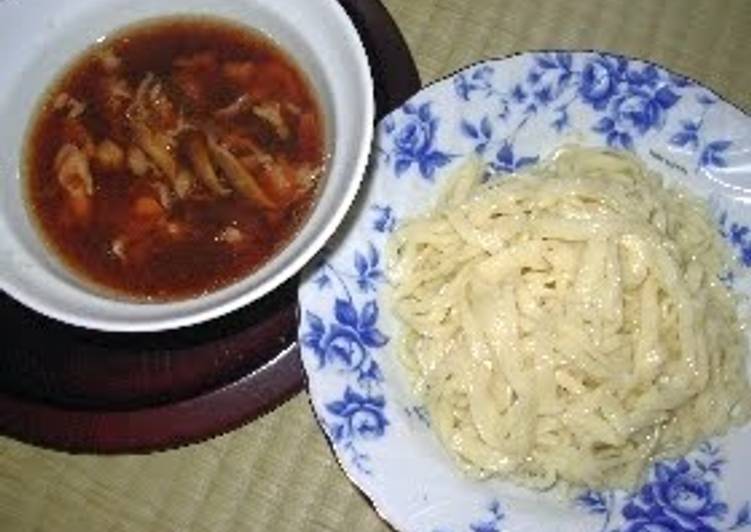
- You could drain the water and wash in cold water for chilled noodles, or serve the noodles in a hot broth. Serve whichever you prefer (I ate the noodles cold).
- I made the noodles for the first time in a while and cut the strands thickly, but they took forever to boil and were difficult to eat. They were delicious, but my jaws were exhausted from the chewing.
- My father gave me a kneading bowl, and so I made these this weekend. FYI, I made the noodles with 850 g of all-purpose flour. The bowl is pretty big.
If you find this My Grandmother's DIY Udon Noodles recipe helpful please share it to your friends or family, thank you and good luck.