Hey everyone, welcome to our recipe site, if you're looking for Ohagi Rice Cakes recipe, look no further! We provide you only the best Ohagi Rice Cakes recipe here. We also have wide variety of recipes to try.
Before you jump to Ohagi Rice Cakes recipe, you may want to read this short interesting healthy tips about {The Simple Ways to Be Healthy. Getting A Healthy Eater
Camp cooking can be as elaborate or simple as you want it to be. If you wish to prepare fast and simple but healthy meals as you are swimming, camp cooking doesn’t even have to need a flame. But if you are interested in ridding your camping excursion using a feast, camp cooking can make it possible for you to earn warm, healthy foods that are as good as you can create them at home in your own kitchen.
Camp cooking does not have to be limited to sandwiches and baked potatoes wrapped in aluminum foil. Almost any cooking procedure you are using in the kitchen can be duplicated around the campfire. For example, use a dutch oven or pit cooking to bake your meals. You might also easily fry foods at a bowl over a grill, or boil, braise and beverage. Which type of camping cookware is best for you? Camp cooking and cleanup may be easy or a hassle, but it all starts with great camping equipment.
Some pots/pans arrive in places that partner collectively or"nest" for storage and even allow you to tuck a spoonful of gas within them. This really also comes in handy when you’re looking to save space whilst camping.
Listed below are some camping items to carry with you if you are considering preparing some meals around the home. These common kitchen items will allow you to duplicate tasty meals while you’re out of doorways.
• Salt and pepper • Other of your favourite herbs and spices • Cooking oil • Pot holder • Hand-held can opener • Aluminum foil • Tongs and spatula • Cutting knives • Cutting board • Mixing bowl • Paper or plastic silverware, plates and cups
In case you have only a couple campers and are searching for some simple camp cooking, try the easy and speedy technique of tin could cooking. All you’ll need is a fresh tin can – a one gallon size may works nicely. Your source of heat can be a little campfire, or if wood burning is prohibited, a little buddy burner will work nicely, which can be located at sporting good stores or online. Place your meal in the tin could and simply heat the contents of your own can over a flame. You will have a hot meal ready in minutes. This technique works great for sauces, beans and tuna fish.
A more time-consuming camp cooking technique that also produces tasty food is pit cooking. It is also a excellent camp cooking method if you are using a dutch oven or cast iron cookware. Pit cooking calms your meals by heating stones and coals which are buried in the floor. As the stones cool off, their emitted heat cooks the food. To pit cook, first dig a hole that is approximately three times larger than your own cookware. Line the pit with stones and create a fire in the center. When the flame has burnt rapidly for approximately an hour, push the hot coals and stone into the middle. Twist your wrapped food or covered skillets in addition to the stones and coals and place on top. After a number of hours, you’ll have some tasty camp food to enjoy.
We hope you got benefit from reading it, now let’s go back to ohagi rice cakes recipe. To cook ohagi rice cakes you only need 5 ingredients and 10 steps. Here is how you cook it.
The ingredients needed to cook Ohagi Rice Cakes:
- Prepare 150 g sticky rice (mochi-gome)
- Provide 180 ml water
- Use some soy bean powder (kinako)
- Prepare some sugar
- Take some bean jam (if you use the canned, you might need to microwave it to dehydrate a little)
Instructions to make Ohagi Rice Cakes:
- Preparation of rice. Wash the rice and put in a colander to drain the water off for a while. Then put it in a bowl (of the rice cooker) with the 180 ml water. Leave it for more than 1 hour.
- Cook the rice. If you don't have a rice cooker, you can use a normal pot and an oven or a microwave. If you use a pot, put a lid and heat it until boiling. Then lower the heat and cook for about 15 minutes. Stop heating and leave it for 10 minutes with the lid on. In case of microwave, put in a microwavable bowl and cover with plastic wrap. Microwave for 5 minutes, then turn over the rice with a big spoon or spatula, and repeat it again. After the last 5-min microwave, leave the bowl in the oven (with the plastic wrap on) for 10 minutes.
- Mash the rice while it is hot. We don't mash it completely but halfway (which is called "half-killing" in Japanese).
- ("Half-killed" sticky rice)
- Prepare the bean jam and the kinako. Microwave the bean jam if it is too wet (be careful, it will be very hot and you may burn your hands. Cool it down). Mix the kinako powder with sugar in a bowl.
- Wet your hand (a bowl of water on your side is useful) and take some of the rice in your hand.
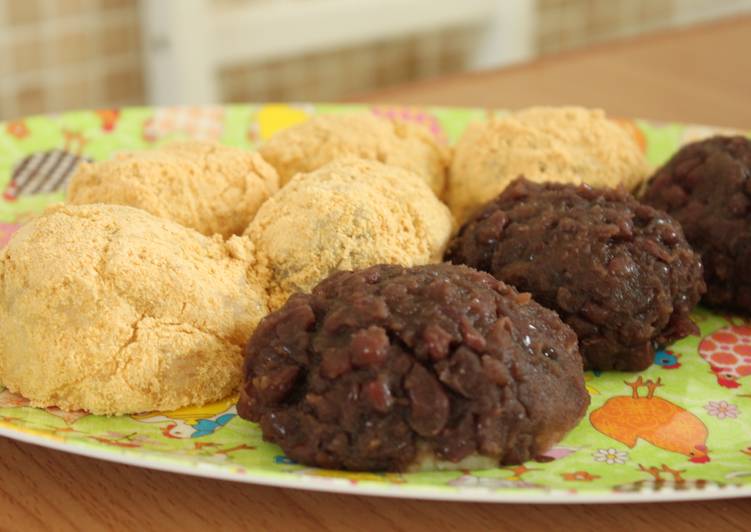
- For Kinako ohagis, spread the rice, put a ball of bean jam and wrap up. Put the rice ball in the bowl of kinako powder.
- For Anko (bean jam) ohagis, make a rice ball and wrap it with the bean jam.
- We must not keep ohagis in a fridge. So it's better eat them as soon as possible.
- I also tried kinako with matcha green tea powder.
In the West, ohagi are found at Japanese markets in the refrigerated section. Anko (sweet bean paste) This is the chocolate brown sweet bean filling that is encased in ohagi (glutinous rice cakes). This Asian rice cakes recipe came from Mama Lin's attempt to make Korean rice cakes, specifically the kind used in tteokbokki. Like in Korean cuisine, steamed rice cakes are prevalent in Chinese. Ohagi (Japanese Sweet Rice with Adzuki Paste).
If you find this Ohagi Rice Cakes recipe valuable please share it to your close friends or family, thank you and good luck.